
Hi, I’m Moxian Qian (钱莫闲) — a master’s student in theoretical physics at Johannes Gutenberg University Mainz (JGU), Germany, also with IQCB and IMB.
I work at the intersection of machine learning and lattice field theory. More broadly I’m drawn to the structure and regularities of physical systems; concretely, I’m interested in new sampling algorithms for physics — in particular ways to get around the sign problem, critical slowing down, and topological freezing. My broader research interests also include mechanistic interpretability of large models.
Outside physics I write a little, listen to a lot of music, and keep a private journal of notes and small experiments.
Reading: Violet Evergarden.
Listening: Our Shared Glory (彼此的光荣) by Silence Wang.
Love life. Be guided by science. Hold life in reverence.
Meet the world with kindness and warmth, and you will arrive where you are meant to be.
Lines I admire — Jensen Huang:
A lot of success comes from really, really hard work.
Greatness is not intelligence. Greatness comes from character. And character isn’t formed out of smart people, it’s formed out of people who suffered.
There’s hard work, and then there’s insanely hard work.
From the Joe Rogan podcast; Stanford SIEPR talk (Mar 2024); NBIM In Good Company (Nov 2023), in that order.
你好,我是 钱莫闲(Moxian Qian)——德国 美因茨大学(JGU)理论物理方向的硕士研究生,同时在 IQCB 与 IMB。
研究方向在 机器学习 与 格点场论 的交界处。更宽泛一点说,比较关心 事物的结构与规律;具体到工作上,是新的物理抽样算法,尤其是如何克服采样里的 符号问题、临界慢化 和 拓扑冻结。此外,我也关注 大模型的机制与可解释性。
物理之外会写点字、听很多音乐,也写一些个人的小笔记和实验记录。
在读:《紫罗兰永恒花园》。
在听:汪苏泷《彼此的光荣》。
热爱生活,信仰科学,敬畏生命。
我们应当怀抱着善良和热诚去生活、去和这个世界的一切交互;而你会去往你最终当去的地方。
很喜欢的几句话 —— 黄仁勋:
很多成功,其实来自非常、非常艰苦的努力。
伟大不来自聪明。伟大来自品格;而品格不是从聪明人身上长出来的,是从那些受过苦的人身上长出来的。
努力是一回事,疯狂程度的努力又是另一回事。
依次出自 Joe Rogan 访谈、斯坦福 SIEPR 讲话(2024 年 3 月)、NBIM《In Good Company》播客(2023 年 11 月)。
news动态
| Jul 20, 20262026 年 7 月 20 日 | New preprint — arXiv:2607.15682 — Neural Non-Equilibrium Hamiltonian Monte Carlo for Corrected Boltzmann Sampling. Building on the path-space correction idea behind SPS, NHMC learns stochastic Hamiltonian paths and introduces a proved shared-bridge round-trip Metropolis correction.新预印本 arXiv:2607.15682 —— Neural Non-Equilibrium Hamiltonian Monte Carlo for Corrected Boltzmann Sampling。在 SPS 路径空间修正思路的基础上,NHMC 学习随机 Hamiltonian 路径,并给出经过证明的共享桥接点 round-trip Metropolis 修正。 |
|---|---|
| Jun 25, 20262026 年 6 月 25 日 | New preprint with Shiyang Chen, Gert Aarts, Biagio Lucini, and Kai Zhou — arXiv:2606.13790 — Stochastic Path Sampler For Lattice Field Theory (co-first authorship with S. Chen).与陈世洋、Gert Aarts、Biagio Lucini、周凯合作的新预印本 arXiv:2606.13790 —— Stochastic Path Sampler For Lattice Field Theory(与陈世洋共同一作)。 |
| Apr 01, 20262026 年 4 月 1 日 | Moved to Mainz and started MSc in theoretical physics at JGU Mainz.来到美因茨,开始 美因茨大学理论物理硕士 阶段。 |
selected publications代表性论文
- arXivNeural Non-Equilibrium Hamiltonian Monte Carlo for Corrected Boltzmann SamplingarXiv preprint, Jul 2026Learned stochastic Hamiltonian paths corrected by recorded non-equilibrium work through path-SNIS, path-IMH, or a proved shared-bridge round-trip Metropolis kernel. Tested on analytic many-well and finite-volume 2D phi^4 targets; molecular and compact U(1) studies retain explicit feasibility boundaries. 用记录的非平衡功修正可学习的随机 Hamiltonian 路径,包括 path-SNIS、path-IMH 和经过证明的共享桥接点 round-trip Metropolis 核。已在解析多阱与有限体积二维 phi^4 上测试;分子和紧致 U(1) 研究保留明确的可行性边界。
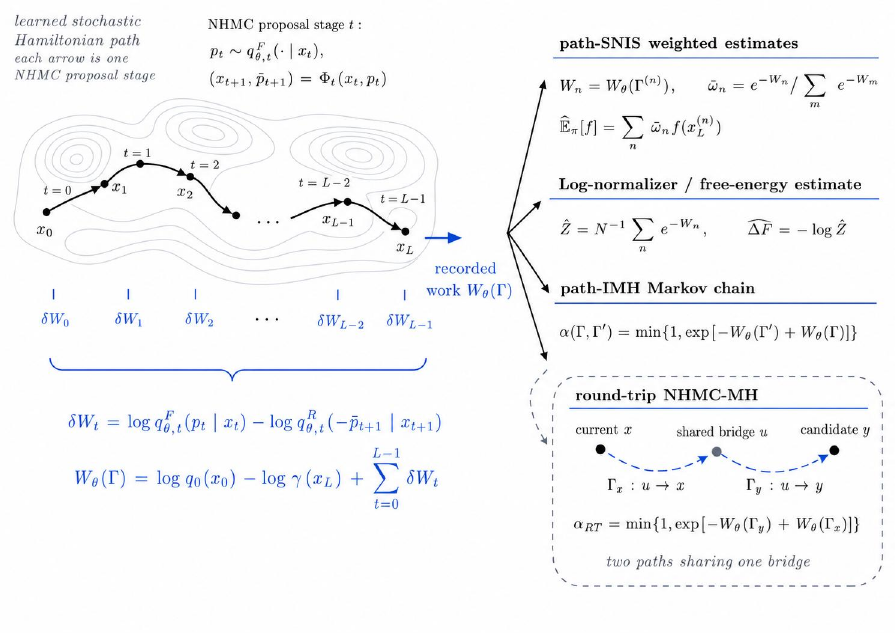 Figure 1. A learned stochastic Hamiltonian path records work that supports path-SNIS, free-energy estimation, path-IMH, and round-trip NHMC-MH. 图 1。可学习的随机 Hamiltonian 路径记录非平衡功,并由此连接 path-SNIS、自由能估计、path-IMH 和 round-trip NHMC-MH。
- arXivStochastic Path Sampler For Lattice Field TheoryarXiv preprint, Jun 2026A data-free neural sampler built from learnable forward/backward stochastic dynamics; matches HMC quality with much shorter autocorrelation near the pseudo-critical region of 2D phi^4. 一种不需要训练数据的神经网络采样器,用可学习的前/后向随机动力学构造;在二维 phi^4 的赝临界区域,能匹配 HMC 的精度但自相关时间短得多。
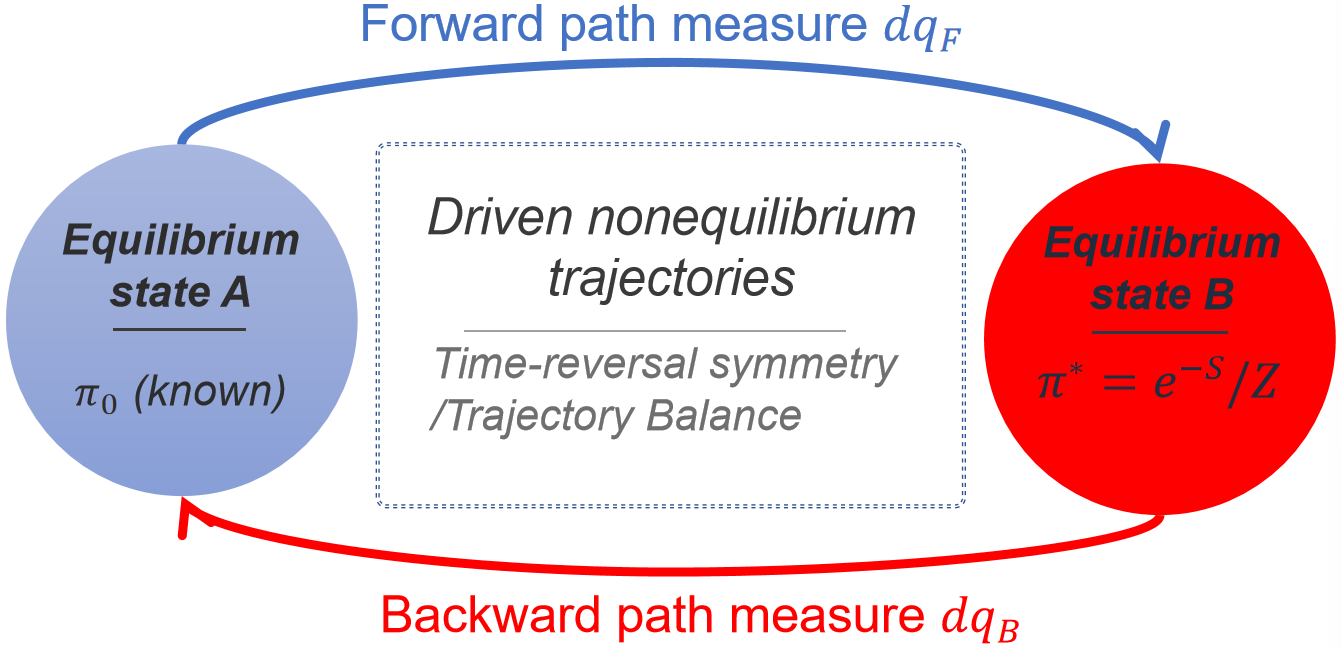 Figure 1. Learned forward and backward path measures connect a known prior to the Boltzmann target; trajectory balance is the organizing principle. 图 1。可学习的前向与反向路径测度连接已知先验和 Boltzmann 目标分布,核心组织原则是轨迹层面的平衡。