Grouped by research theme; within each theme reverse-chronological.按主题分组,组内按时间倒序。
ML samplers & Boltzmann distributions机器学习采样与玻尔兹曼分布
arXiv
Neural Non-Equilibrium Hamiltonian Monte Carlo for Corrected Boltzmann Sampling
Moxian Qian
arXiv preprint, Jul 2026
Learned stochastic Hamiltonian paths corrected by recorded non-equilibrium work through path-SNIS, path-IMH, or a proved shared-bridge round-trip Metropolis kernel. Tested on analytic many-well and finite-volume 2D phi^4 targets; molecular and compact U(1) studies retain explicit feasibility boundaries.用记录的非平衡功修正可学习的随机 Hamiltonian 路径,包括 path-SNIS、path-IMH 和经过证明的共享桥接点 round-trip Metropolis 核。已在解析多阱与有限体积二维 phi^4 上测试;分子和紧致 U(1) 研究保留明确的可行性边界。
Figure 1. A learned stochastic Hamiltonian path records work that supports path-SNIS, free-energy estimation, path-IMH, and round-trip NHMC-MH.图 1。可学习的随机 Hamiltonian 路径记录非平衡功,并由此连接 path-SNIS、自由能估计、path-IMH 和 round-trip NHMC-MH。
Sampling from an unnormalized Boltzmann density requires proposals that move probability mass globally while retaining enough path-probability information for statistical correction. We introduce Neural Non-Equilibrium Hamiltonian Monte Carlo (NHMC), a train-then-correct learned Hamiltonian sampler. Starting from a tractable base distribution, NHMC learns stochastic Hamiltonian-style paths toward the target. Once training is complete, the learned proposal parameters are fixed; the proposal then generates complete paths and endpoint configurations, which are statistically corrected using the recorded non-equilibrium work. This dimensionless generalized work is determined by the probability ratio between the forward proposal path and a reverse reference path. During training, minimizing its mean reduces a path-space KL divergence and controls an upper bound on endpoint mismatch. During evaluation, the same quantity defines weights for self-normalized importance sampling on paths (path-SNIS), estimates normalizing constants or free-energy differences, and gives the acceptance ratio for path-space independent Metropolis-Hastings (path-IMH). The same forward-reverse laws also define a shared-bridge round-trip Metropolis kernel that acts directly on configurations and preserves the Boltzmann target. On double-well and finite-volume lattice phi^4 targets, the NHMC construction gives corrected estimates when path overlap is sufficient; when overlap is poor, weight degeneracy, low acceptance, and long autocorrelation expose proposal failure. We additionally report a molecular internal-coordinate feasibility study using an MD prior and learned-force path proposal.
@article{qian2026nhmc,title={Neural Non-Equilibrium Hamiltonian Monte Carlo for Corrected Boltzmann Sampling},author={Qian, Moxian},journal={arXiv preprint},year={2026},month=jul,archiveprefix={arXiv},primaryclass={cs.LG},}
arXiv
Stochastic Path Sampler For Lattice Field Theory
Shiyang Chen, Moxian Qian, Gert Aarts, and 2 more authors
arXiv preprint, Jun 2026
A data-free neural sampler built from learnable forward/backward stochastic dynamics; matches HMC quality with much shorter autocorrelation near the pseudo-critical region of 2D phi^4.一种不需要训练数据的神经网络采样器,用可学习的前/后向随机动力学构造;在二维 phi^4 的赝临界区域,能匹配 HMC 的精度但自相关时间短得多。
Figure 1. Learned forward and backward path measures connect a known prior to the Boltzmann target; trajectory balance is the organizing principle.图 1。可学习的前向与反向路径测度连接已知先验和 Boltzmann 目标分布,核心组织原则是轨迹层面的平衡。
In lattice field theory, target distributions are known only up to normalization, while the partition function is generally intractable. Markov chain Monte Carlo simulations often become inefficient near phase transitions or the continuum limit due to critical slowing down. We propose a novel sampler based on nonequilibrium thermodynamics, called Stochastic Path Sampler (SPS), which can generate configurations for the unnormalized target distribution without a need for training data. The central idea is to establish a trajectory-level balance for learnable forward and backward stochastic dynamics between two equilibrium states—the prior and target distributions—by minimizing the path-space variational free energy, equivalently an entropy-production upper bound. The learned forward process provides independent proposals, subsequently corrected by an extended-space Independence Metropolis–Hastings step. In two-dimensional phi^4 theory, our neural sampler matches HMC’s sampling quality with a much shorter autocorrelation time in the pseudocritical region. SPS offers a stochastic-quantization-inspired route to data-free proposal construction for lattice field theory.
@article{chen2026sps,title={Stochastic Path Sampler For Lattice Field Theory},author={Chen, Shiyang and Qian, Moxian and Aarts, Gert and Lucini, Biagio and Zhou, Kai},journal={arXiv preprint},year={2026},month=jun,archiveprefix={arXiv},primaryclass={hep-lat},}
arXiv
Variational Autoregressive Networks Applied to φ^4 Field Theory Systems
Moxian Qian and Shiyang Chen
arXiv preprint, Dec 2025
Trains autoregressive networks via reinforcement learning for data-free sampling on Ising and phi^4; small Metropolis-Hastings corrections on top of the network proposals reduce residual bias while keeping high sample efficiency.用强化学习训练自回归网络,对 Ising 与 phi^4 做无数据采样;在网络提议之上叠加小的 Metropolis-Hastings 修正,降低残余偏差同时保持高采样效率。
Figure 1. In an analytic two-dimensional Gaussian-mixture example, VAN samples s1 and then s2 conditional on s1, routing a unimodal prior into the two modes of the target.图 1。在解析的二维 Gaussian-mixture 例子中,VAN 先采样 s1,再根据 s1 条件采样 s2,把单峰先验中的样本送入目标分布的两个模态。
Figure 5a. In the 2D phi^4 benchmark, VAN+Block MH follows the HMC magnetization curve where the uncorrected VAN shows residual bias.图 5(a)。在二维 phi^4 基准中,未修正的 VAN 出现残余偏差,而 VAN+Block MH 的磁化强度结果重新贴近 HMC 曲线。
We combine reinforcement learning with variational autoregressive networks (VANs) to perform data-free training and sampling for the discrete Ising model and the continuous phi^4 scalar field theory. We quantify the complexity of the target distribution via the KL divergence between the magnetization distribution and a reference Gaussian distribution, and observe that configurations with smaller KL divergence typically require fewer training steps. Motivated by this observation, we investigate transfer learning and show that fine-tuning models pretrained at a single value of kappa can reduce training time compared with training from a Gaussian field. In addition, inspired by single-site and cluster Monte Carlo updates, we introduce single-site and block Metropolis-Hastings (MH) updates on top of VAN proposals. These MH corrections systematically reduce the residual bias of pure VAN sampling in the parameter range we study, while maintaining high sampling efficiency in terms of the effective sample size (ESS). For both the Ising model and the phi^4 theory, our results agree with standard Monte Carlo benchmarks within errors, and no clear critical slowing down is observed in the explored parameter ranges.
@article{qian2025van,title={Variational Autoregressive Networks Applied to $\phi^4$ Field Theory Systems},author={Qian, Moxian and Chen, Shiyang},journal={arXiv preprint},year={2025},month=dec,archiveprefix={arXiv},primaryclass={hep-lat},}
Mechanistic interpretability可解释性的一种
arXiv
Operator Spectroscopy of Trained Lattice Samplers
Moxian Qian
arXiv preprint, May 2026
Generative Boltzmann samplers still hit scaling, unbalanced mode weights, and mode collapse. Gauge fields make this worse: an equivariant architecture is almost required, so training becomes expensive. This work therefore reads off the analytic operator bases a trained network actually uses, and asks whether those bases can be built into a smaller architecture that trains more cheaply.生成式玻尔兹曼采样器仍然会碰到标度问题、模态权重失衡和模态崩溃。规范场让这件事更糟:几乎必须用等变架构,训练因此非常贵。本文由此读出训练后网络实际用到的解析算符基,并问这些基能不能做进一个更小的架构,从而更便宜地训练。
Trained lattice samplers are usually judged by the ensembles they generate. Here we instead analyze the trained field-space function itself: a flow-matching velocity, a diffusion score, or a normalizing-flow action residual. We project these functions onto operator bases fixed before the fit, chosen from symmetry, exact Gaussian path limits, finite-volume modes, and gauge covariance. For two-dimensional lattice phi^4, a trained straight-flow teacher is not described by a local force basis alone. After the local transport basis, the residual separates into a zero-mode Binder component and a lowest-shell finite-k correlator component. The same projection also distinguishes other sampler classes: diffusion follows the force-resolvent ordering predicted by the free theory, reverse-KL normalizing-flow collapse appears as a forbidden odd zero-mode residual, and gauge-equivariant teachers are resolved by Wilson-loop-force tangent directions.
@article{qian2026spectroscopy,title={Operator Spectroscopy of Trained Lattice Samplers},author={Qian, Moxian},journal={arXiv preprint},year={2026},month=may,archiveprefix={arXiv},primaryclass={hep-lat},}
General relativity广义相对论
CPB
Gravitation induced shrinkage of Mercury’s orbit
Moxian Qian, Xibin Li, and Yongjun Cao
Chinese Physics B, 2020
Identifies a gravitation-induced secular contribution to the shrinkage of Mercury’s orbit, beyond the standard relativistic perihelion precession.在标准的相对论性近日点进动之外,识别出一项引力诱导的水星轨道长期收缩贡献。
We analyze a gravitation-induced contribution to the secular shrinkage of Mercury’s orbit, in addition to the standard relativistic perihelion precession.
@article{qian2020mercury,title={Gravitation induced shrinkage of Mercury's orbit},author={Qian, Moxian and Li, Xibin and Cao, Yongjun},journal={Chinese Physics B},volume={29},number={10},pages={109501},year={2020},doi={10.1088/1674-1056/ab9f24},publisher={IOP Publishing},}
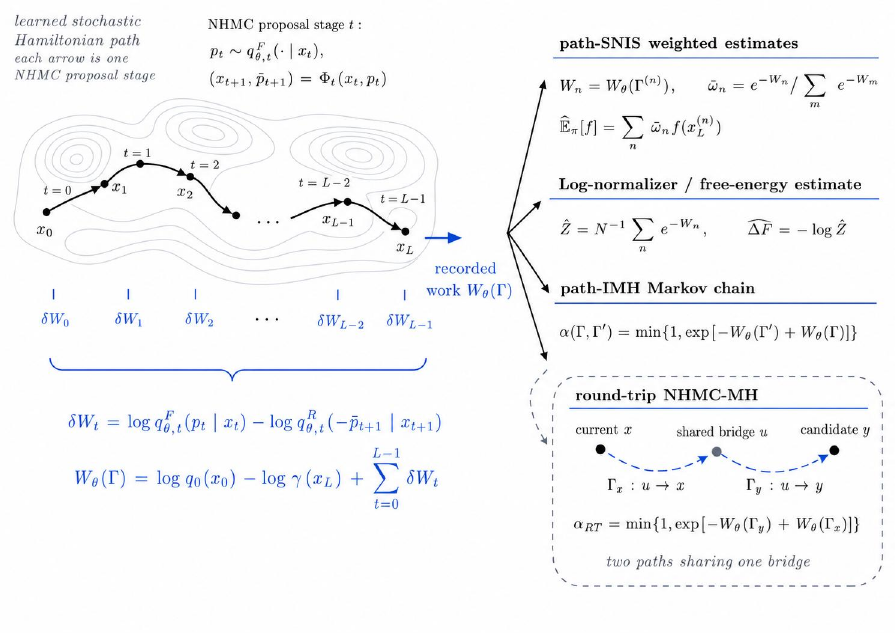 Figure 1. A learned stochastic Hamiltonian path records work that supports path-SNIS, free-energy estimation, path-IMH, and round-trip NHMC-MH. 图 1。可学习的随机 Hamiltonian 路径记录非平衡功,并由此连接 path-SNIS、自由能估计、path-IMH 和 round-trip NHMC-MH。
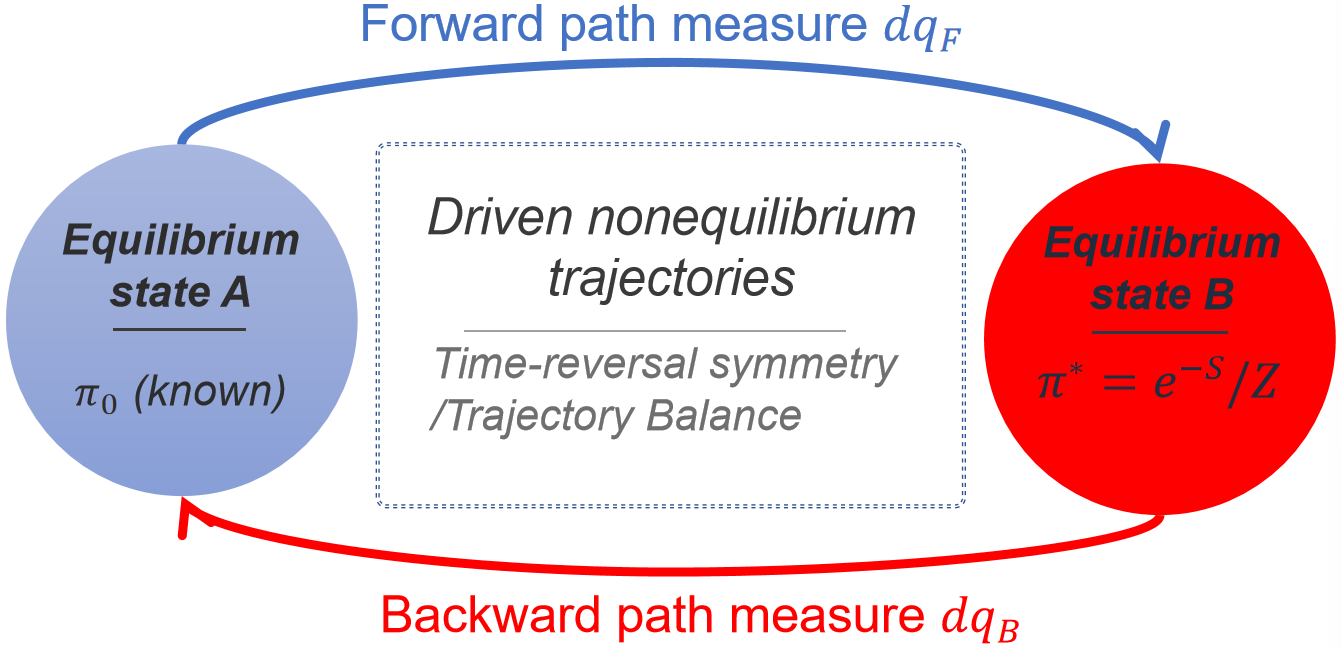 Figure 1. Learned forward and backward path measures connect a known prior to the Boltzmann target; trajectory balance is the organizing principle. 图 1。可学习的前向与反向路径测度连接已知先验和 Boltzmann 目标分布,核心组织原则是轨迹层面的平衡。
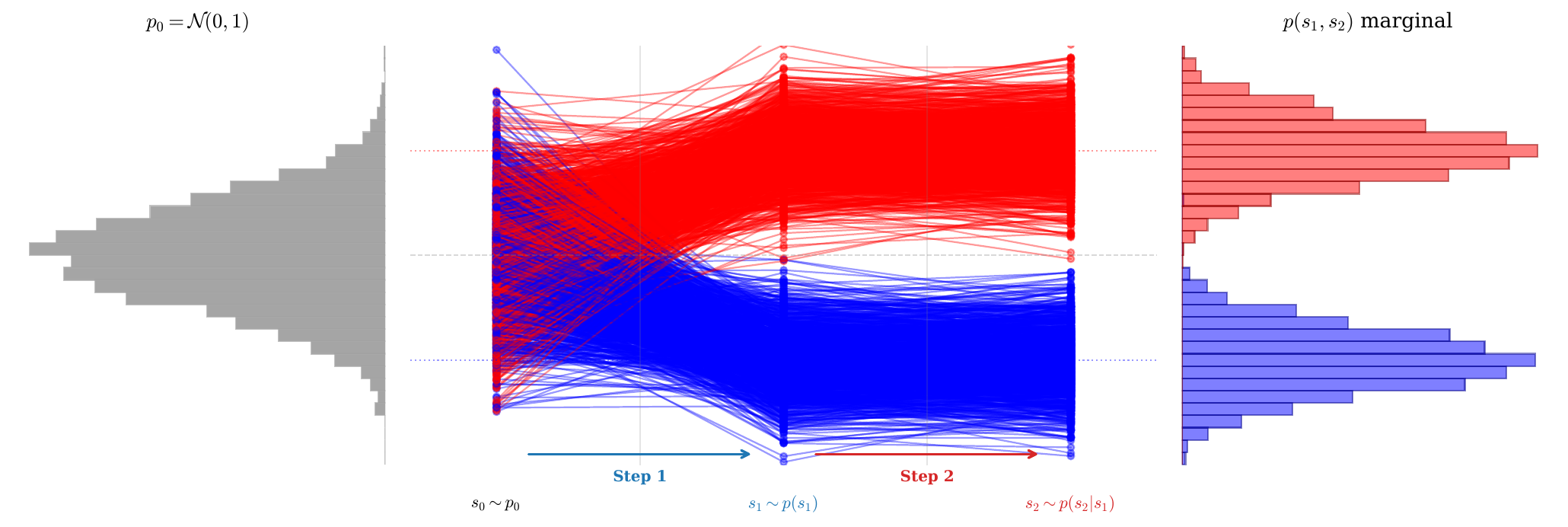 Figure 1. In an analytic two-dimensional Gaussian-mixture example, VAN samples s1 and then s2 conditional on s1, routing a unimodal prior into the two modes of the target. 图 1。在解析的二维 Gaussian-mixture 例子中,VAN 先采样 s1,再根据 s1 条件采样 s2,把单峰先验中的样本送入目标分布的两个模态。
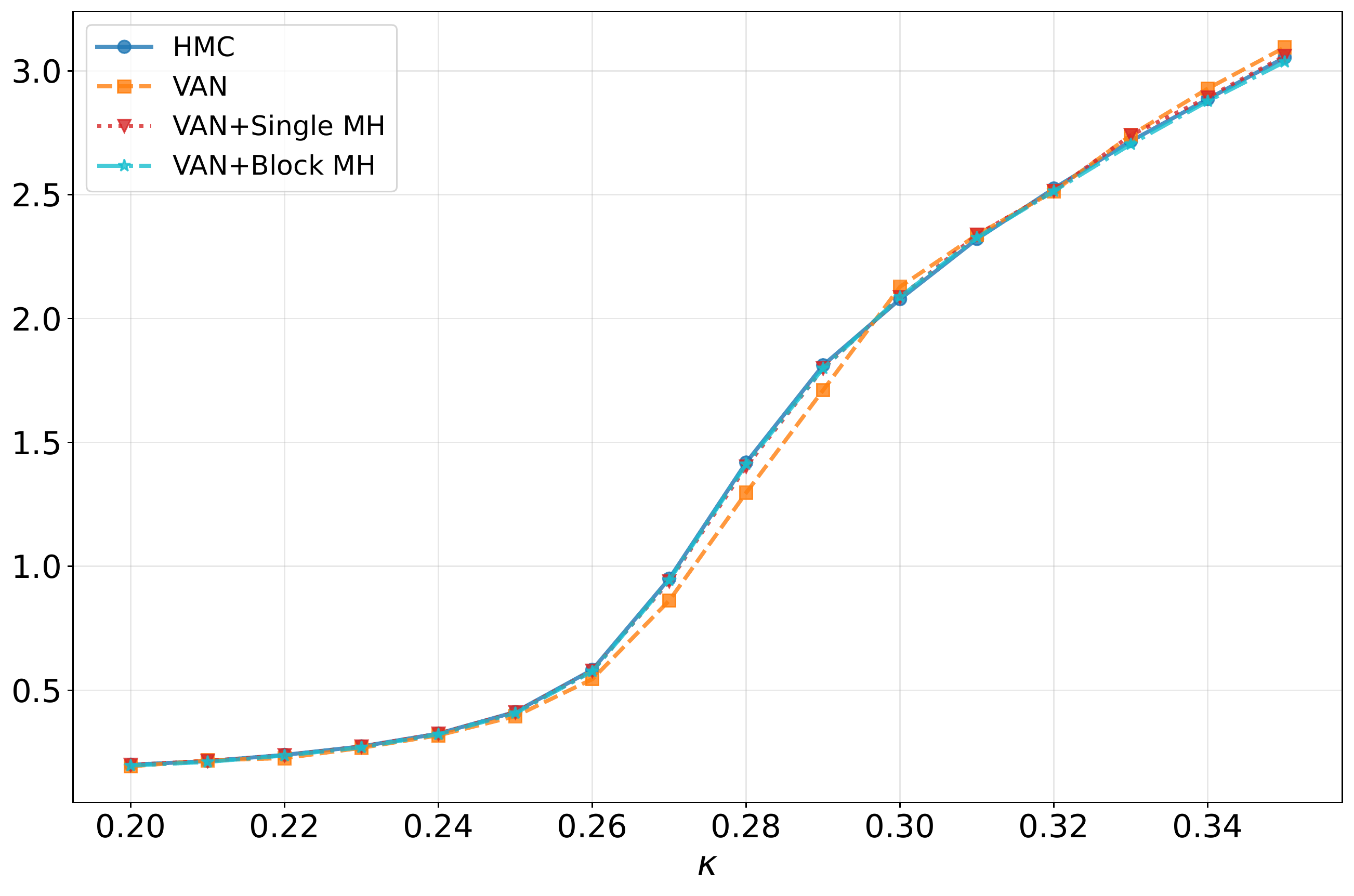 Figure 5a. In the 2D phi^4 benchmark, VAN+Block MH follows the HMC magnetization curve where the uncorrected VAN shows residual bias. 图 5(a)。在二维 phi^4 基准中,未修正的 VAN 出现残余偏差,而 VAN+Block MH 的磁化强度结果重新贴近 HMC 曲线。